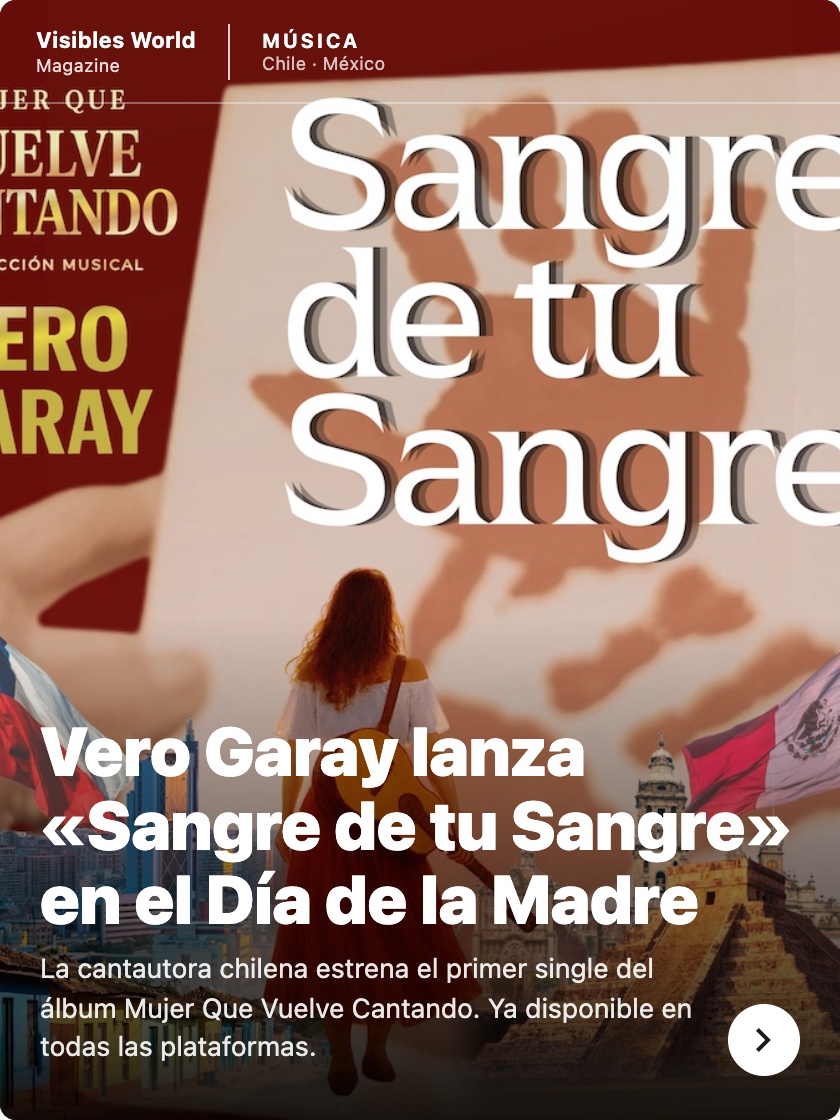
Vero Garay is about to release a new musical album born between roots, teaching, emotional migration and music as a shared home. In this new chapter, Vero Garay presents an album that not only crosses territories between Chile and Mexico, but also proposes something more intimate: a return to oneself.
The recent story of Vero Garay carries that pulse of trajectories slow-cooked on sensitive heat. A Chilean singer-songwriter, a teacher in Puerto Aventuras, an artist trained in singing and deeply connected to her surrounding community, her new production opens a map made of her own songs, traditional Mexican repertoire and a search that feels clear from the very first moment: to return singing to the essence.
In times when so much music is consumed at scroll-speed, what Vero Garay offers feels closer to a long after-dinner conversation, to a notebook with margin notes, to an old photograph that keeps saying new things. Her album Mujer que vuelve cantando (Woman who returns singing) condenses memory, identity, femininity, belonging and gratitude. All without grandiloquence. Rather with closeness, craft and a deeply Latin American sensitivity.
An artist born among music, teaching and family heritage
The story of Vero Garay begins in Santiago, Chile, inside a family where music and education were already present as a natural current. In her account a beautiful image appears: her grandmother, a concert pianist, sitting her on her lap while playing. According to her family, that little girl would stay serene, listening. There was already a first founding scene there, as if hearing had understood before the words.
The training of Vero Garay also went through church, school, pastoral work and those spaces where singing is not yet a formal career but is, indeed, a way of being in the world. From a young age she went from one place to another performing songs. That early practice was building something more than experience: an organic relationship with the voice.
"Teaching is a blessing."
That formative dimension did not remain only in the artistic realm. Vero Garay has also built a life in teaching, and that part is central to understanding her present. She talks about teaching as a vocation of constancy, an exchange where one gives and at the same time receives. In her view, what happens in the classroom and what happens in the song touch each other: opening the heart, sharing a truth and discovering that something of it also resonates in other people.
Chile and Mexico: two homes in one voice
One of the most luminous parts of the conversation around Vero Garay is her way of speaking about Mexico. She does so with gratitude, with closeness and with a sense of belonging that does not seek exaggerations. For her, setting foot in Mexico, sharing in its culture and learning from it is a privilege.
Instead of stating rigid distances, Vero Garay recognizes deep affinities between both countries. She says that culturally Chile and Mexico are very similar, so much so that here she feels at home. That phrase is no small matter. In migrant artists, the idea of home tends to move. Sometimes it ceases to be a fixed address and becomes a sum of bonds, flavors, words, accents and affections.
"We all fit here in Mexico."
There is also a very clear acknowledgment of Mexican interpretive power. She is moved by that way of singing that goes straight to the soul, that allows one to cry a song, toast and continue with another. In her reading, Mexican culture has an immense, varied, warm, expressive richness. And that dialogues very well with her own musical search, which does not pretend to lock itself into a single stylistic purity.
"Mujer que vuelve cantando": the concept of an inward return
The heart of this creative stage lies in the album Mujer que vuelve cantando. The title has something cinematic about it: a figure in motion, a journey, an emotion underway. But its meaning goes even deeper. Different people would tell Vero Garay that it was beautiful that she was returning singing to Mexico or returning singing to Chile. And she was tuning a different answer: the real return was towards herself.
"I return singing to myself, I return singing to my roots, I return singing to essence, I return accepting myself, loving myself, without criticism."
That fragment summarizes with precious clarity the spirit of the record. It is not just about geography. Nor about nostalgia in its simplest form. There is something more complex and at the same time more gentle: a reconnection with one's own identity, with what remains when the scenarios change, with the possibility of looking at oneself without harshness.
Six original songs and three Mexican pieces with a Chilean signature
The structure of the record also says a lot about Vero Garay's vision. The production brings together six songs of her own authorship and three deeply symbolic Mexican pieces: La Martiniana, La Bruja and La Sandunga. The choice does not seem casual. They are pieces loaded with history, territory, cultural memory and feminine strength.
What is interesting is that these songs arrive with a sonority crossed by the Chilean identity of the project. Vero Garay speaks of a mixture between Latin American roots music and bossa nova. That definition already suggests a specific color: something that can have earth, cadence, intimacy, breeze, wood and movement.
"My style is a mixture. I am not puritan, not at all."
Within that production, important names appear in the creative process. Alejandro "Janito" Rivera is in charge of the musical arrangements, and Gonzalo Maldonado is also part of the work. Vero Garay additionally shares the longing to bring these musicians to Playa del Carmen to offer concerts.
"Sangre de tu sangre": a song for the mother, told in life
If the album has a particularly sharp emotional center, that moment seems to arrive with Sangre de tu sangre (Blood of your blood), a song that Vero Garay composed thinking of her mother. Here another sensitive key of her work appears: gratitude in life. Saying it now. Singing it now. Honoring the story while the presence still accompanies.
"This song is called Sangre de tu sangre and it is a song I made thinking of my mom, and the most beautiful thing is being able to give this thanks while she is still alive."
The piece was recorded at her parents' old house, a space loaded with memories, stories and objects that keep time. Bruno Torres was in charge of the video direction. That decision to film in an old family home makes the artistic gesture even more intimate.
Teaching as creative territory
There is something especially coherent in the way Vero Garay links her musical career with her educational work. In her account they do not appear as separate worlds. Rather they feed each other. The school setting, children, theater, rehearsals, shared musicality: all of that also forms part of her artistic identity.
She currently participates actively in school productions and in the musical direction of stage projects. She mentions, for instance, the presentation of Lion King at the Teatro de la Ciudad, with performances and joint work between students, direction and educational community.
Puerto Aventuras and the community that made the project possible
One of the most generous moments of this conversation arrives when Vero Garay openly thanks the Puerto Aventuras community and also the Santiago, Chile community. She says it with total clarity: this production would not have been possible without the economic and human support of the people who believe in her.
"This production could not have been born without the Puerto Aventuras community and the Santiago, Chile community."
That kind of acknowledgment completely changes the tone with which a musical release is usually discussed. Here the isolated figure of the artist-genius suspended in a cloud does not appear. A network appears. Parents of family, friendships, people from the north and south of Chile, people from Puerto Aventuras, bonds of trust.
A voice that never stopped singing
In the conversation a simple and powerful question appears: whether she ever stopped singing. Vero Garay's answer was brief and conclusive. Never. Even if she doesn't go through life singing at every step, even if other responsibilities exist, singing has remained there.
Perhaps that is why Mujer que vuelve cantando does not sound like artificial reinvention. It sounds more like decantation. Like a stage where many layers of life settle and finally find the right format to come out with a name of their own.
Where to listen to Vero Garay
For those who want to follow Vero Garay's music, her digital presence is already open on different platforms. She can be found on YouTube as Vero Garay Oficial, in addition to Spotify, Apple Music, DistroKid and her official website: verogaray.com.
Why this album connects
The proposal of Vero Garay connects because it has emotional truth and artistic structure at the same time. There is craft, there is history, there is work with arrangers, there is conscious repertoire selection, there is community, there is educational setting, there is migrant identity and there is a very clear intimate thesis: to return to oneself with care.
Frequently asked questions about Vero Garay
Who is Vero Garay?
Vero Garay is a Chilean singer-songwriter based in Mexico, as well as a music teacher linked to the Puerto Aventuras community. Her artistic work unites singer-songwriter compositions, traditional Mexican repertoire and a sensitivity marked by Latin American roots.
What is Vero Garay's new album called?
Vero Garay's new album is called Mujer que vuelve cantando (Woman who returns singing). The project revolves around the idea of returning to essence, to roots and to loving self-recognition.
What kind of music does Vero Garay make?
Vero Garay defines her style as a mixture of Latin American roots music with bossa nova. Her proposal also incorporates singer-songwriter compositions and traditional Mexican pieces reinterpreted from a Chilean sensitivity.
How many songs does the Mujer que vuelve cantando album include?
The album brings together nine songs: six compositions by Vero Garay and three Mexican songs: La Martiniana, La Bruja and La Sandunga.
Which is the song Vero Garay dedicated to her mother?
The song is called Sangre de tu sangre. Vero Garay composed it thinking of her mother and presents it as a way of thanking her in life.
Where can you listen to Vero Garay's music?
Vero Garay's music is available on YouTube as Vero Garay Oficial, as well as Spotify, Apple Music, DistroKid and her official website verogaray.com.
What role did the community play in Vero Garay's project?
Vero Garay acknowledges that the Puerto Aventuras community and close people from Santiago de Chile were fundamental to making the album production possible, both from human accompaniment and from financial support.
What is Vero Garay's relationship with Mexico?
Vero Garay lives in Mexico, feels deeply grateful to its culture and considers the country a second home. That connection is reflected in her daily life, her teaching work and the inclusion of Mexican repertoire within her new album.